Emerging Climate Risks for India’s Wind Power Sector
Bridging the Gap Between India’s 140 GW Ambition and the Reality of Declining Wind Speeds Through Parametric Insurance

India has long relied on its abundant wind resources as a cornerstone of its renewable energy ambitions. In recent years, however, an emerging challenge threatens to undercut this progress. A measurable decline in wind speeds and wind energy potential across the country is visible. This trend has already led to shortfalls in power generation and loss of revenue for wind farm operators, raising concerns among renewable energy producing companies, investors, and policymakers.
Wind Energy Generation in India – Target vis-à-vis Trend
Wind power is a key part of India’s energy mix, with about 50 GW of installed wind capacity (the 4th highest in the world) as of early 2025. Wind farms generated roughly 60 billion kilowatt-hours of electricity in 2020–21, accounting for around 4–5% of India’s total power production and about 10% of India’s total renewable energy generation.
India’s government has set ambitious targets to expand wind energy generation 140 GW by 2030, underscoring its vital role in meeting future demand and climate goals. However, evidence shows that India’s wind resource has been weakening in recent decades. This comes at an inopportune time – just as the country is striving to scale up, wind speeds are declining, potentially undermining the output.
Multiple studies have identified a downward trend in India’s wind energy potential, especially since the turn of the 21st century. The decline is most pronounced in the western and southwestern states – regions like Gujarat, Maharashtra, and Tamil Nadu – which collectively host over 70% of India’s wind power capacity.
For example, India’s total wind power output in the 2020 monsoon season (June–September) was 24% lower than in the same period of 2019. In the wind-rich western region, generation fell nearly 29%, and in the south about 17%. July 2020 was especially poor – some areas saw over a 40% drop in wind generation, referred to as a “wind drought” by experts.
A primary driver appears to be alterations in the Indian summer monsoon system due to climate change. Scientists attribute this to a warming Indian Ocean and shifting atmospheric patterns. The western Indian Ocean has warmed significantly, weakening the land-ocean pressure gradient that drives monsoon winds.
Impacts on Wind Power Generation and Revenue
The summer of 2020 provided a stark demonstration: with wind output plummeting ~30–40% at many projects, wind energy companies across India saw a significant hit to their revenues. An executive in the sector noted that he had “never seen anything like this” in his career, as the June–September 2020 period accounted for only a fraction of the usual three-fourths of annual wind generation. This shortfall not only squeezed the cash flows of wind farm operators, but also began to unnerve lenders and investors amidst ongoing deals in the renewable energy space. After all, if the cornerstone assumption of wind projects – i.e. the expected wind resource – is in doubt, it “could throw a spanner in the works” for India’s wind energy expansion plans.
Illustration of annual power generation (2000–2025) for a 3 MW wind plant in Western India
Project developers typically finance wind farms based on long-term production estimates (often derived from historical wind data). But as climate-driven shifts cause actual winds to deviate from the past, those estimates can be overoptimistic. This has a cascading effect on stakeholders: wind power producers struggle to meet their generation targets, reducing their earnings, and lenders to these projects face higher default risk if projects cannot generate the expected revenue to service debt.
India’s renewable energy roadmap assumes continuously increasing output from wind farms to meet future targets. If wind variability and “low-wind years” become more frequent, renewable energy companies could face revenue instability on a regular basis. This would not only strain their operations but could also make investors and banks more cautious in funding new wind projects (or demand higher returns to compensate for the risk). Ultimately, a persistent wind slowdown could act as a drag on India’s clean energy transition – unless the industry finds ways to adapt and mitigate this risk. Some adaptation measures are long-term, like improving climate forecasting, diversifying the geographic location of wind farms, or even increasing turbine hub heights to capture stronger winds aloft. However, one immediate financial tool is already emerging to address the revenue shortfall side of the equation: parametric insurance.
Parametric Insurance: Safeguarding Wind Energy Revenues
Given the difficulty of controlling or precisely predicting the weather, risk transfer through insurance is a logical component of the solution. Traditional insurance policies, however, do not cover lack of wind or low energy output – they typically only cover physical damage (for instance, if a turbine is damaged by a storm). Parametric insurance, on the other hand, offers an innovative alternative, tailored for situations exactly like this where natural variability (too little wind) causes financial loss. In a parametric insurance policy, payouts are triggered by a predefined parameter or index (such as measured wind speed or simulated energy production) rather than by physical damage. This means if the chosen index falls below a certain threshold – indicating a wind shortfall – the policy pays out automatically, helping to make up for lost revenue.
Over the past few years, specialized insurers and insurtech firms have begun offering parametric covers for wind farm revenue protection in India and globally. The rationale is simple: “wind yield volatility” is an emerging risk that can leave wind operators’ balance sheets exposed. Parametric products can hedge that risk.
For example, one such solution creates an index of expected annual energy output for a given wind farm (based on historical wind data and the turbine power curve). If at the end of the year the actual wind speeds are significantly lower than normal, resulting in “simulated” generation falling below the indexed threshold, the policy triggers a payout to the wind farm operator. Unlike conventional insurance, there is no need to prove damage or liability – if the data-driven trigger condition is met, the payout is issued, often within weeks, providing a fast financial relief to the operator. This kind of cover is essentially a financial hedge against wind resource risk, bringing peace of mind to operators, developers, and their investors. It ensures that even in a bad wind year, the project’s cash flow can be bolstered by insurance, stabilizing the revenue stream.
Illustration of a parametric insurance payout for low wind speed
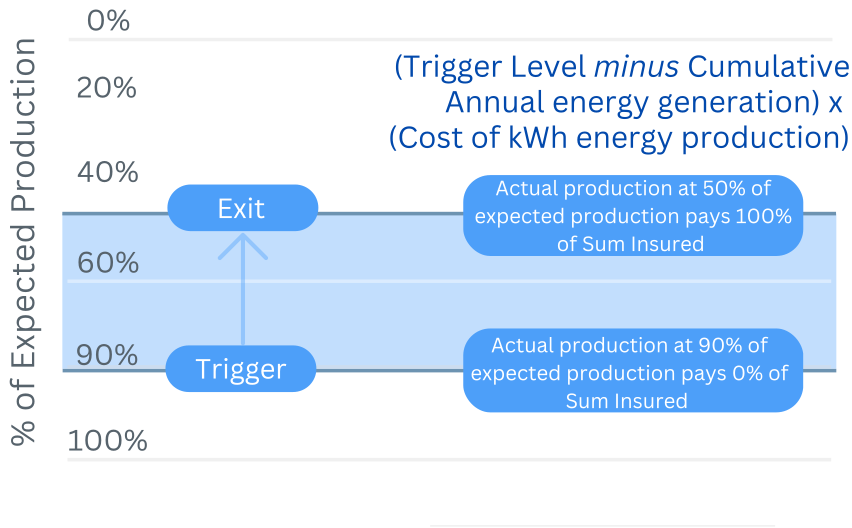
Parametric insurance offers customized protection aligned to each project’s location, turbine profile, and historical wind data, with fully transparent, data-driven triggers agreed upfront. As payouts are linked to predefined indices rather than loss assessments, claims are settled rapidly – often within days – providing timely financial relief during low-wind periods and helping stabilize cash flows and debt servicing.
Driving Adoption of Parametric Insurance in India’s Wind Sector
As India’s wind resource becomes increasingly variable, the effectiveness of parametric insurance will depend not only on product design but also on how it is delivered to the market. A well-structured go-to-market (GTM) strategy is therefore essential to ensure that wind power producers, investors, and lenders can readily adopt this new category of financial protection. Three themes play a central role: bundled offerings, embedded distribution, and targeted industry engagement.
Bundled Solutions with OEMs and O&M Providers
Wind turbine manufacturers and O&M service providers are uniquely positioned to distribute parametric covers because they already maintain long-term relationships with wind farm operators. Traditional availability guarantees offered through O&M contracts do not address low-wind risk; bundling a parametric “wind revenue stability” add-on closes this coverage gap.
This bundling unlocks several advantages:
- ·
Operators receive a unified package covering both mechanical availability and resource volatility.
- ·
OEMs differentiate their service offerings in a competitive market.
- ·
Insurers gain access to distributed fleets of turbines without needing to acquire customers one project at a time.
- ·
Such integrated offerings can become a new industry norm, particularly in regions where monsoon-driven wind variability is expected to increase.
Embedded Insurance in Project Finance and Corporate PPAs
Revenue volatility affects lenders and corporate energy buyers just as much as wind farm owners. As a result, embedding parametric insurance directly into financial arrangements significantly enhances adoption.
Two pathways stand out:
1. Project Finance Packages - Banks, NBFCs, and public-sector financiers can embed parametric protection within loan structures. Payouts during low-wind years help preserve DSCR, lowering the perceived credit risk of the project. This allows lenders to offer more favorable financing terms while improving bankability for developers.
2. Corporate Renewable PPAs - Large industrial offtakers seeking stable green power supply face exposure when wind generation falls short. Embedding parametric insurance within long-term PPAs ensures performance stability, helping buyers manage procurement risks and maintain sustainability commitments even during climate-driven wind anomalies.
Portfolio-Level and Multi-Site Adoption
Large independent power producers (IPPs) with geographically diverse fleets benefit from portfolio-level parametric structures. Instead of insuring each project separately - which can be more expensive and less efficient aggregated or regional wind indices provide smoother payouts and lower premium costs. This portfolio approach aligns closely with how IPPs manage risk internally and can significantly accelerate adoption among utility-scale players.
Conclusion
In summary, the decrease in wind availability is a real and pressing issue impacting energy generation and related investments in India. However, innovative insurance solutions like parametric covers can help the industry adapt by transferring the revenue risk away from wind farm operators.
As India marches toward its renewable energy goals, coupling such risk transfer mechanisms with traditional development strategies will be key to weathering the uncertainty. With wind patterns changing, parametric insurance could become an instrumental tool in keeping India’s wind energy journey on track – providing financial stability to power generators even when the wind itself does not blow in their favor.
References
- 1
Srivastava, G. (2021). “Not enough wind?”: Decrease in wind availability impacting the energy generation and related investments in India.
- 2
Bhaskar, U. (2020). India’s wind power generation down 40% during peak season.
- 3
- 4
Descartes Underwriting (2023). Parametric Insurance Against Wind Power Volatility in India.
- 5
- 6